
The Employer Success Program
Fewer repeat injuries, claims and blind spots, measured against where you started.
Most companies with 50 to 500 employees carry the risk of a much bigger company, and nobody has the job of managing it. It gets split between the owner, the CFO, HR and operations. The Employer Success Program is how Duncan Financial Group fills that seat.
Start a conversationOur processIt starts with a written Diagnostic and Plan
Before anything else happens, you get findings in writing. Every one of them reads the same way.
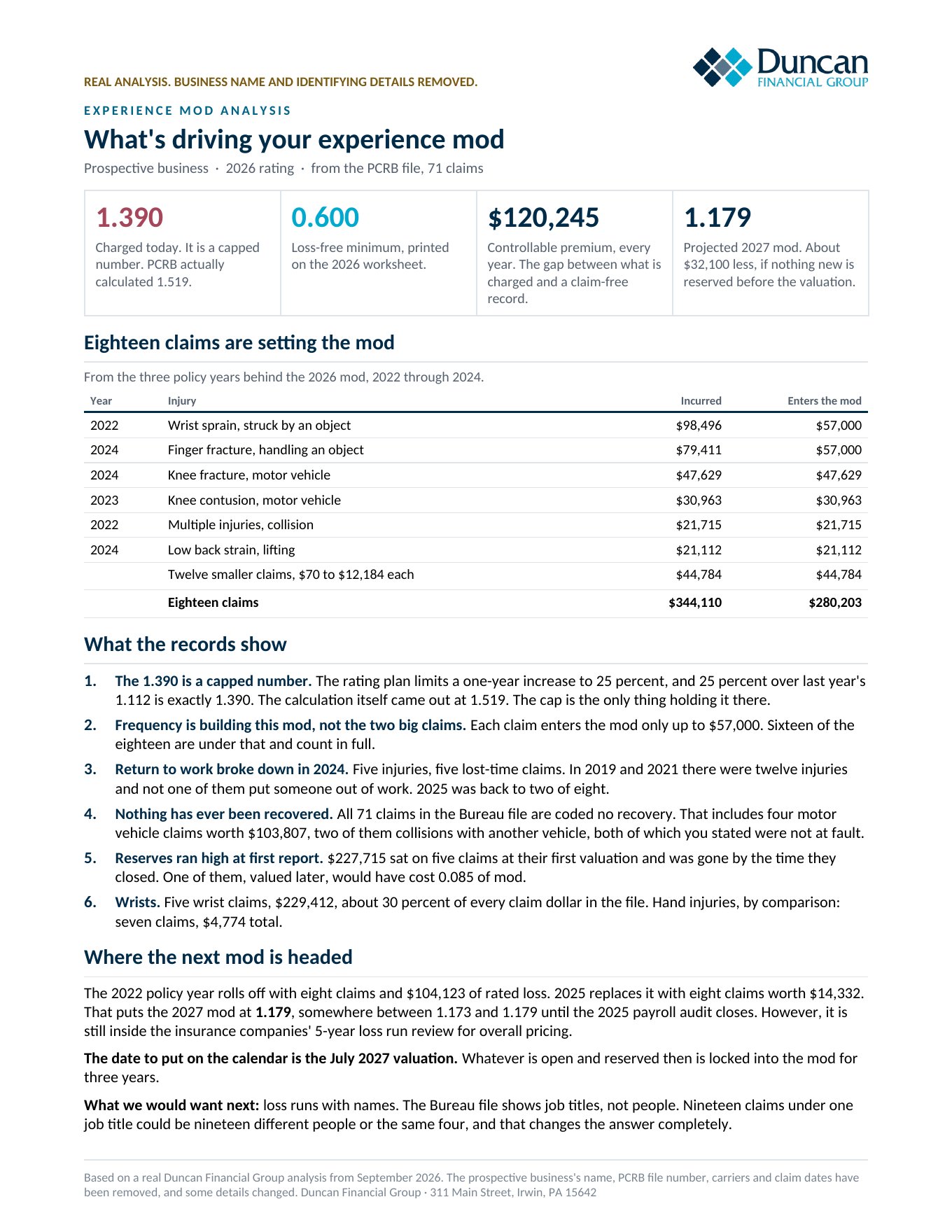
Illustration of the format. Your findings come from your own loss runs, your mod worksheet and your contracts.
Most plans carry somewhere between six and a dozen of these, ordered by what is worth doing first rather than what is easiest to say.
Who it's for
Companies with roughly 50 to 500 employees, usually in one or more of these situations.
- The mod is over 1.0 or climbing, nobody can tell you exactly why, and it may be keeping you off bid lists.
- The same injuries keep happening in the same jobs.
- The premium went up even though there were few or no claims.
- The company is growing: more people, more vehicles, more locations, more contracts.
- You sign contracts nobody has checked for what they make you responsible for.
- You're not sure how long the business could keep paying people and bills after a fire or a long shutdown.
- Things are going well, and you want to know what you might be missing before it shows up.
What you stand to gain
Lower premiums, overcharges recovered, and fewer of the same claims coming back year after year.
Fewer open shifts and less overtime, less of your managers' week on the same problem, and a mod low enough to bid the work that requires it.
Evacuation plans and drills, contracts that don't hand you someone else's risk, and coverage built around what it really takes to rebuild, reopen and get through the months until customers and cash flow come back.
When an accounting firm compiled the results for clients who had been in the process at least two full years, it found a 61% reduction in the number of employee injuries, a 78% reduction in the number of lost-time injuries, and a 93% reduction in total injury costs. Yours will depend on where you start. More on the results
What the program includes
A Diagnostic and Plan
We read your loss runs, your mod worksheet and your key contracts, and we walk your facility or jobsites with the people who run the work. You get a written report: what we found, the financial impact of each finding, quantified where the information supports it, and a ranked list of what to fix first. Then we sit down and walk through it with you. Sometimes a problem costs more to fix than it's costing you. We'll tell you that.
Specialists who do the work with you
Our claims, HR, safety and fleet people work alongside your managers all year, on whatever your plan calls for. Your managers own the changes in their departments. We bring the expertise, the materials and much of the legwork.
Prevent the repeat problems
Written procedures, supervisor training, the safety committee, and how people are hired and brought on.
Manage injuries and claims
Return-to-work programs, reserve reviews with adjusters when the facts support a change, and follow-up with the doctor, the employee and the insurance company.
Prepare for a major disruption
Contracts reviewed before you sign, property and business income coverage built around what it really takes to rebuild and reopen, and evacuation plans and drills. Three businesses that came back
A Score Card
A baseline at the start, a Score Card every year after and a results review every quarter. Injuries, lost time, claim cost, the mod and what you pay, tracked against your own starting point.
An underwriter who can see the difference
At renewal, or whenever we test the market, we put the evidence in front of underwriters: what changed in the operation, and the numbers behind it.
How the improvements last
Training fades and rules get worked around. What lasts is how the company runs day to day, so that's where the work goes.
- Leaders follow through. The owner and managers walk the floor, take incident reports personally, and make safety part of how supervisors are judged.
- Accountability runs both ways. Management provides clear standards, the right tools, the training and the time. Employees report problems early and speak up when someone is at risk.
- Supervisors fix the cause. When someone gets hurt, they look at the job, the equipment, the schedule and the training behind it, not just the person.
- It gets measured and reinforced. The Score Card shows what changed, and the quarterly review catches drift before it shows up in claims.
That's what keeps the results coming: fewer disruptions, lower costs, stronger performance, and the premium savings that follow.
How it works, start to finish
- A 30-minute conversation. What's happening, what you've tried, and whether a closer look makes sense.
- The Diagnostic and Plan, at no cost. You send the documents, we review them, talk with your people and visit your facility or jobsites.
- The written report and a review meeting. Findings, their financial impact, quantified where the information supports it, and what to fix first.
- You decide. The Diagnostic doesn't commit you to anything. If you go forward, we agree on the scope together.
- The ongoing program. It's paid for through the commission on the insurance we place for you. Some programs may include a fee, which you'll know and agree to before you sign.
What it asks of your team
Someone who can make decisions, and one person on your side to be our point of contact. Your managers own the changes in their own departments. We bring the expertise, the materials and much of the legwork.
To start, we usually need your loss runs, your current mod worksheet, payroll by class code, your policies and your key contracts. If you don't have the mod worksheet, we can get it with a signed letter from you.
We start with the one or two changes worth the most, so it doesn't turn into another project nobody has time for.
What it looked like for others
Over $70 million saved since 2004
Premium reductions and recovered overcharges for our clients.
59% lower premium
Renewal offer vs. premium several years into the program
16 injuries a year down to one or two. A $421,000 renewal offer came down to a $172,000 premium.
Read the story75% lower premium
Renewal offer vs. premium several years into the program
24 injuries a year, then two years with none. The mod went from 1.483 to 0.727.
Read the story1.21 to 0.93
A mod that kept them out of corporate bids. Two years later it was under the 1.00 those bids required.
Read the storyDuncan met with me and my employees, toured my facility and put together an aggressive Risk Solutions Business Plan. They started implementing immediately and are in our plant several times each and every month. Working together, we have now taken back control of what was an “out of control” Workers Compensation Program.
Robert Gottlieb, CEO, Gottlieb, Inc.
In all my years doing this, I had never gone through a process like what Duncan put us through. They came on-site, did a full Risk Assessment, and found blind spots in our fleet, our employee safety practices, and our facilities that we did not know we had.
Joe Cilone, BSN, LNHA, HSE, President & Co-Owner, Inspira Health Group
I could not help but think that if I was still with that old program, I would be out of business today.
Ken Clifton, Owner, CCF Industries
The first step
A 30-minute conversation on Teams. We talk through what's happening, what you've already tried, and whether a closer look is worth it. No documents needed to book.
If it makes sense for both of us, the next step is the Diagnostic and Plan. If it doesn't, you'll at least know what's worth looking into.
The Diagnostic is at no cost and doesn't commit you to anything. You see the findings before you decide.
Rather send a message?
Tell me a little about your company and what's going on. I read these myself and reply within two business days. If a closer look isn't worth it, I'll tell you that.